Jiuzhaigou ("Nine Village Valley") is the single most photographed landscape in Sichuan — a chain of impossibly turquoise lakes stacked up a Tibetan valley, ringed by snow peaks and primeval forest. Locals sum it up with one line: *"Once you've seen Jiuzhaigou, no other water compares."*
This guide is written for travellers who have already decided to go and now need to solve the practical puzzle: which month, how to get there now that the high-speed train has arrived, how the ticket and quota system actually works, which valley to see first, and whether Huanglong is worth the extra day. Everything below was checked against the park's own 2025–2026 notices and our Chengdu team's on-the-ground notes.
What Makes Jiuzhaigou Special
Jiuzhaigou sits in Zhangzha Town, Jiuzhaigou County, in the Aba (Ngawa) Tibetan and Qiang Autonomous Prefecture of northern Sichuan, roughly 400 km from Chengdu. It was inscribed as a UNESCO World Heritage Site in 1992, and it earns that status on three counts at once.
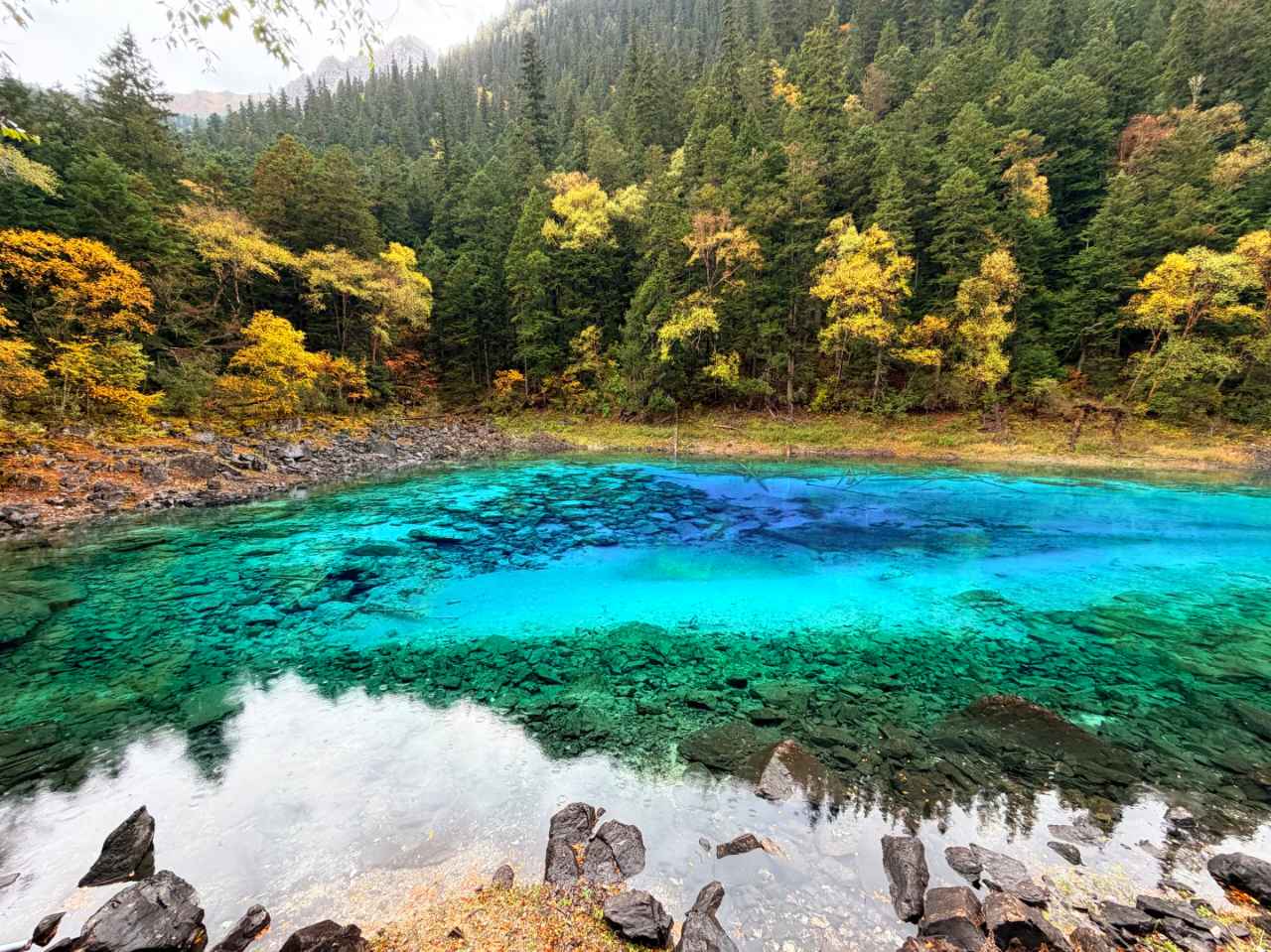
Lakes. The park holds more than a hundred alpine lakes — the locals call them *haizi*, "sons of the sea" — created when travertine (dissolved limestone) dams natural stream beds. Because the water is mineral-rich and the lakebeds are pale, light does something odd here: the lakes read as sapphire, emerald, turquoise and jade, often all in one frame. Five Flower Lake (五花海) is the famous one, and it deserves the hype.
Waterfalls. The valleys drop in steps, so the water falls in steps too. Nuorilang Waterfall (诺日朗瀑布) is the widest in China, and Pearl Shoal (珍珠滩) spreads into a curtain of white over a fan of rock.
A living Tibetan valley. Jiuzhaigou is not an empty park. Nine Tibetan villages gave the valley its name, and several remain active, with prayer flags, water-wheel prayer wheels and small guesthouses around the edges of the reserve.
Why is Jiuzhaigou a World Heritage site? UNESCO lists it for the combination of its travertine lake-and-waterfall system, its forest ecosystems and its habitat for endangered species — including the giant panda and the golden snub-nosed monkey. It is a natural site, not a cultural one, but the Tibetan villages inside it are protected as part of the listed landscape.
Best Time to Visit Jiuzhaigou
Jiuzhaigou looks different in every season, and there is no single "wrong" time — but there is a clear peak.
| Season | Months | What You Get | Crowds |
|---|---|---|---|
| Spring | Mar–May | Thawing lakes, fresh green, blossoms, low prices | Low |
| Summer | Jun–Aug | Full water flow, lush forests, waterfall season | High |
| Autumn | late Sep–early Nov | Peak colour — gold, orange, red reflected in the lakes | Very high |
| Winter | Dec–Feb | Frozen waterfalls, blue ice, snow, half-price tickets | Low |
What is the best month to visit Jiuzhaigou? For most first-timers, late October to early November is the magic window. Autumn colour peaks as the forests turn and the lakes hold their colour, and the reflections are at their most intense. The trade-off is crowds: this is also when tickets sell out fastest, so book weeks ahead.
If you would rather trade colour for calm, winter is the contrarian pick. The waterfalls freeze into blue ice, the travertine terraces stay vivid, tickets drop to the off-season price, and you may have viewpoints almost to yourself. Summer delivers the biggest water volumes but coincides with the rainy season, so watch the forecast. Spring is quiet and green, though the colour palette is at its most muted.
A note on timing: park hours and the daily quota shift between peak and off-season (both covered below), so always confirm your exact travel dates against the park's official notice before you book.
Getting There: The New High-Speed Train
For two decades, "how do I get to Jiuzhaigou?" had one honest answer: a long, winding road. That changed on August 30, 2024, when the Sichuan–Qinghai Railway opened its Zhenjiangguan–Huangshangguan section, plugging Jiuzhaigou and Huanglong directly into China's high-speed network.
By high-speed train (the new default). Trains run from Chengdu East Station to Huanglongjiuzhai Station (黄龙九寨站) in as little as 1 hour 39 minutes. Around ten pairs of trains run daily, departing Chengdu from early morning and returning until roughly 9 p.m., so a weekend round trip is now realistic. Ticket prices use flexible, demand-based pricing on the 12306 app, typically in the ¥120–180 range one-way for second class.
How long is the train from Chengdu to Jiuzhaigou? The train itself is under two hours. From Huanglongjiuzhai Station, board the connecting shuttle bus at the station — about 1 hour 50 minutes to the Jiuzhaigou park entrance, or roughly 30 minutes to Huanglong. Buses are timed to meet arriving trains ("随到随走" / depart when full).
By plane. Jiuzhai Huanglong Airport (JZH) sits about 50 km from the scenic area and connects Chengdu, Chongqing, Beijing, Xi'an and other cities. Flights are fast (about 40–60 minutes from Chengdu) but the airport is at 3,448 m and prone to fog and low cloud, especially November to March — winter delays and cancellations are common. Landing here also drops you straight into high altitude with no acclimatisation.
By road. Self-driving from Chengdu takes around 7–8 hours on the historic route, though the Jiumian Expressway has cut the driving time toward roughly 4 hours and added a second, faster road option. Most visitors now combine the train out with a road or flight return, or simply fly one way.
Is there a high-speed train to Jiuzhaigou? Yes — as of late 2024, direct high-speed trains link Chengdu and Huanglongjiuzhai Station, making the train the fastest and most reliable way in for most travellers.
Tickets, Quotas & Booking Rules
Jiuzhaigou runs a strict "limited, reserved, off-peak" (限量、预约、错峰) system. You cannot just turn up and buy a ticket at the gate — there is no on-site sales window. Everything is booked online with real names in advance.
Ticket prices (2025–2026):
| Season | Dates | Entrance | Sightseeing bus | Total |
|---|---|---|---|---|
| Peak | Apr 1 – Nov 15 | ¥190 | ¥90 | ¥280 |
| Off-season | Nov 16 – Mar 31 | ¥80 | ¥80 | ¥160 |
An optional ¥10 insurance is offered at checkout. Discounts apply: children under 1.2 m or under 6 are typically free; seniors 60+ and a range of concession groups get reduced or free entrance (the bus fee usually still applies). Peak-season pricing is roughly ¥280 per adult all-in, or about US$39.
Daily quota. The park caps entry at 41,000 visitors per day in peak season and about 23,000 in the off-season. On busy dates the cap is reached and sales close — sometimes days or weeks in advance. Booking is released up to 14 days ahead, and during peak periods (national holidays, late October) the park itself advises booking around 20 days out.
How do I book? Two official channels only: the WeChat official account "九寨沟" (through the "门票预定" menu) or the Aba Tourism Network at abatour.com. Both require your passport details. Beware of resellers promising "fast entry" or cheap tickets through unofficial channels — they are frequently invalid.
How much is Jiuzhaigou entry? ¥190 in peak season plus ¥90 for the mandatory sightseeing bus, or ¥80 + ¥80 in the off-season. The bus is effectively required: the valley is too long to walk end to end.
Do Jiuzhaigou tickets sell out? Yes, routinely. The 41,000 daily cap is hit on autumn weekends and every national holiday. If your dates are firm and fall in peak season, book the moment the 14-day window opens. There is also a waitlist (候补) mechanism on the official mini-program: if tickets are sold out, visitors within 40 km of the park can register and receive any cancelled tickets automatically, in order.
Park hours. In the 2025 season, entry runs 7:30–14:00 (no new entries after 14:00), with the park closing at 18:00. Getting in early is not just about crowds — the light on the lakes is best in the morning.
### Shuttle bus explained
Inside the park you travel by sightseeing bus, which loops the three valleys in a "Y" shape. It works like a hop-on, hop-off service: buses run frequently along the trunk and branch roads, and you can get off at any stop, walk a stretch of boardwalk, and re-board at the next station. Because the valleys are long and the highlights are spread out, most visitors ride the bus to a far point and then work their way back downhill on foot, letting the bus carry them between clusters.
### One-day route strategy
If you only have one day, the classic strategy is first bus up, walk down. Ride the earliest shuttle to the far end of Rize Valley (the right arm of the "Y") and walk downhill through Primitive Forest, Grass Lake and Swan Lake toward the signature stops — Arrow Bamboo Lake, Panda Lake, Five Flower Lake and Mirror Lake — arriving at Five Flower Lake mid-morning when the light is strongest. Break at Nuorilang for lunch and the waterfall, then ride up Zechawa Valley (left arm) to Long Lake and Five Colour Pool, and finish by working back through Shuzheng Valley. It is a full, efficient day.
One Day vs Two Days in the Park
Can you see Jiuzhaigou in one day? You can see the headline sights, yes — a single well-planned day covers all three valleys by shuttle and hits Five Flower Lake, Long Lake and Nuorilang. But it is a fast day, and you will spend a lot of it moving.
Two days change the experience. On a second day you can walk the boardwalks instead of riding, catch the lakes in different light, slow down at Mirror Lake and the quieter corners of Shuzheng Valley, and — crucially — add Huanglong as a separate excursion without cramming it in. Because tickets are valid for a single day and are park-specific, two days means booking two separate entry tickets. For most overseas travellers who have crossed the world to get here, two days is the better call.
The Three Valleys: What Not to Miss
The park's "Y" has a shared trunk (Shuzheng Valley) that forks into two arms. Here is what each arm is actually for.
Shuzheng Valley (trunk). The first valley you enter and the last you leave, so you will see it twice. Highlights are Shuzheng Lakes, Rhinoceros Lake, Tiger Lake and the Shuzheng Waterfall, plus the Tibetan village and water wheels near the start. Save detailed exploring for the return leg.
Rize Valley (right arm). The scenery showcase, and where most of the iconic photos come from. Do not miss Five Flower Lake, Panda Lake, Arrow Bamboo Lake, Mirror Lake (glass-flat reflections on a calm morning) and the walk through Primeval Forest at the top. If you do only one arm properly, do this one.
Zechawa Valley (left arm). The high-altitude arm, with fewer stops but two majors: Long Lake (长海), the largest and deepest lake in the park, and the small but intensely coloured Five Colour Pool (五彩池) a short walk below it. Zechawa is more about the wide mountain setting than the intimate water shots.
Huanglong National Park: Worth the Detour?
Huanglong ("Yellow Dragon") is Jiuzhaigou's sister UNESCO site — and the two are usually mentioned in the same breath because they are close and share transport infrastructure. But they are genuinely different places.
How far is Huanglong from Jiuzhaigou? Roughly 100–130 km, or about 1.5–2.5 hours by road, depending on route and conditions. From the new Huanglongjiuzhai Station, the shuttle to Huanglong takes only about 30 minutes.
Where Jiuzhaigou is about still lakes, Huanglong is about flowing water over stone. The valley climbs a snow-fed hillside through thousands of travertine terraces — tiered pools in blue, green, gold and milky white — ending at the Five Colour Pool (五彩池) near the top of the valley at around 3,576 m. It is the single most spectacular single feature of the region, and many travellers argue it outshines Jiuzhaigou.
The catch is altitude. Huanglong's boardwalks climb to roughly 3,600–3,700 m, which is high enough to cause mild altitude sickness if you rush. The smart play is to ride the cable car up and walk down, a route that saves both energy and climbing time and takes about four to six hours at a relaxed pace. Entrance is around ¥170 in the main season and about ¥60 in the low season, with the cable car roughly ¥80 one-way; buy oxygen canisters at the base if you are sensitive to altitude.
Is it worth the detour? If you are already at Jiuzhaigou and can spare a day, yes — Huanglong is a different kind of beautiful and the train makes it logistically easy. If you have only a rushed single day at Jiuzhaigou, adding Huanglong is not realistic; come back for it rather than shortchanging both.
Jiuzhaigou + Huanglong Tour Options
You can absolutely build this trip independently — the train, shuttle buses and online ticketing make it feasible for a confident traveller. But the Jiuzhaigou–Huanglong loop has three moving parts that punish poor planning: a ticket quota that sells out, altitude that rewards a sensible pace, and transport legs that need to line up. That is where a guided option earns its keep.
The most common setups:
- Independent, train-based (2–3 days). High-speed train Chengdu ↔ Huanglongjiuzhai, shuttle to Zhangzha Town, one or two days in Jiuzhaigou, optional day trip to Huanglong.
- Guided Jiuzhaigou + Huanglong (3–5 days). A local team handles tickets, transfers, altitude pacing and the Huanglong day, usually with a private car between the two parks. This is our honest recommendation for first-time visitors from overseas, especially families and anyone worried about altitude.
- Extended nature itineraries. If you want Jiuzhaigou as part of a longer run through Sichuan's highlands, it pairs naturally with other parks and nature routes.
Our recommended way to see both parks in one trip is the Natural Sichuan Five-Day Tour, which flies in and out of the alpine region and bundles Jiuzhaigou's lakes, Huanglong's travertine pools, the round-trip bullet train and a Tibetan welcome feast into a single itinerary — the tickets, timing and altitude pacing are handled for you.
If you would rather shape your own dates, themes and pace — Jiuzhaigou and Huanglong with pandas, or with food, or on a slower photography schedule — start from our custom Sichuan trip planner, where the same local team builds a private itinerary around what you actually want.
Where to Stay
There is no accommodation inside Jiuzhaigou Valley — the park enforces "sleep outside, visit inside" (沟内游、沟外住), so everyone beds down in Zhangzha Town (漳扎镇) at the park entrance, or in the nearby Jiuzhaigou county town.
Zhangzha Town has the widest range, from simple guesthouses to international-standard and five-star hotels, plus restaurants, shops and the Tibetan cultural attractions of the surrounding area. Staying here means you are minutes from the gate for the early entry slot.
A few practical notes:
- Book early for peak season. Autumn and national holidays fill the good hotels weeks out.
- Altitude is mild at the gate (about 2,000 m) — much lower than Huanglong — so Zhangzha Town is a comfortable base even for altitude-sensitive travellers.
- Cash and connectivity. Mobile payment and Wi-Fi are reliable in town, but carry some cash for small vendors.
Frequently Asked Questions
Do I need a visa to visit Jiuzhaigou? It depends on your passport. China's visa-free entry and visa-free transit policies cover many nationalities, and Chengdu's airports are eligible transit ports. Check the current rules for your country before booking — policies are updated periodically. If you are coming from Chengdu, you are already inside China, so the visa question is settled at your point of entry.
How many days do I need for Jiuzhaigou? Two days is ideal — one full day for the three valleys and a second for either a slower return to the park or a Huanglong excursion. One rushed day is possible but tight; three days lets you add Huanglong comfortably.
When is the best time to visit? Late October to early November for autumn colour and reflections, or winter (December to February) for frozen waterfalls, snow and half-price tickets with far fewer people.
Can I visit Jiuzhaigou and Huanglong in one trip? Yes — and you should. They are about 1.5–2.5 hours apart by road and share the same station, so a two- to three-day loop covers both.
Is Jiuzhaigou open now? Yes. The park fully reopened after the 2017 earthquake and restoration work, and has operated with the quota and online-booking system since. Always check the park's official notice for your exact dates in case of seasonal closures or weather events.
Is altitude a problem? At Jiuzhaigou itself, no — the valley floor sits around 2,000–3,100 m and most visitors feel fine. Huanglong is the higher, harder day at up to ~3,700 m; take the cable car up, walk down slowly, and allow yourself to acclimatise first.
Do I need to book the train in advance? During peak season, yes. Tickets go on sale about two weeks ahead on the 12306 app, and popular morning departures sell out. Book the train after you have your park tickets, or before if your dates are flexible.
Last Updated: October 12, 2026 · This article is reviewed by our Chengdu-based team and re-verified quarterly against the park's official notices.
Disclaimer: Ticket prices, opening hours, daily visitor quotas, transport schedules and visa policies are set by Chinese authorities and park management and are subject to change without notice. This article is for general guidance only and does not constitute booking, immigration or safety advice. Always confirm current details through the park's official channels (WeChat "九寨沟" / Aba Tourism Network), the 12306 railway app, and your country's Chinese Embassy before travel.
Sources:
- Jiuzhaigou Scenic Area official notices and booking channels (WeChat "九寨沟" · Aba Tourism Network, abatour.com)
- Sichuan–Qinghai Railway opening reports (Xinhua / CNR / China Railway, Aug 2024) — Chengdu East ↔ Huanglongjiuzhai Station, ~1h39m
- Huanglong Scenic Area official information and UNESCO World Heritage listing (Jiuzhaigou Valley, inscribed 1992)
- China Railway 12306 timetable and ticketing app